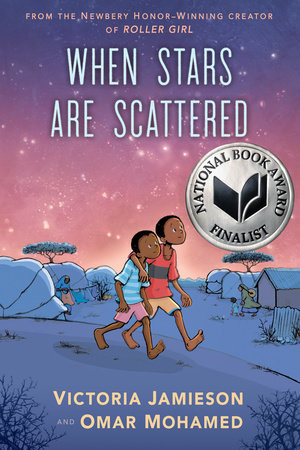
When Stars Are Scattered — Victoria Jamieson & Omar Mohamed (2020)
Brief Summary (No Spoilers)
When Stars Are Scattered tells the true story of Omar Mohamed, who spent his childhood in the Dadaab refugee camp in Kenya after fleeing civil war in Somalia. The memoir centers on Omar's responsibility for caring for his younger brother Hassan, who is nonverbal, while navigating education, uncertainty, and the hope of resettlement. Through graphic storytelling, the book presents both the daily realities and the emotional complexity of life in a refugee camp.
Why I Chose This Book
I chose this book because it amplifies refugee voices through an accessible format that does not diminish the gravity of the subject matter. As a librarian, I am particularly interested in texts that expand global perspectives and humanize experiences that students may only encounter through headlines.
Reflection
When Stars Are Scattered is a deeply moving graphic novel memoir that tells the true story of Omar Mohamed and his younger brother, Hassan, growing up in a refugee camp in Kenya after fleeing war-torn Somalia. The narrative combines Omar's personal reflections with the vivid, expressive illustrations of Victoria Jamieson, creating a text that is both emotionally rich and visually compelling. The memoir does more than recount events - it invites the reader into the lived experience of displacement, uncertainty, resilience, and hope. The graphic format humanizes what could be abstract or distant, making it accessible and impactful for young adult readers.
What Stood Out
1. Humanizing a Global Issue - Displacement and refugee life are topics that many students may only encounter through news stories. This memoir brings those realities to a personal level, showing how Omar and Hassan navigate daily life, uncertainty about the future, and the responsibility of caring for family.
2. Graphic Memoir as an Empathy Bridge - The illustrations are integral to meaning, not decorative. Ficial expressions, spatial layouts, and symbolic imagery deepen the emotional resonance. For adolescent readers, the visual narrative creates a bridge into experiences that might otherwise feel distant or overwhelming.
3. Resilience Without Simplification - The story does not shy away from hardship, but it emphasizes agency, ingenuity, and hope. Omar's determination to seek education, care for his brother, and engage with community resources shows resilience that feels authentic and inspiring. The memoir reminded me that young people are capable of profound insight and agency even in the most difficult circumstances. For the classroom and library, this book serves as a gateway to discussion about global citizenship, equity, and the shared human experience.
Personal Reaction
Reading When Stars Are Scattered was both grounding and enlightening. I was struck by how much weight each small decision carried for Omar and Hassan, whether it was choosing food, navigating bureaucratic challenges, or holding onto hope for resettlement.
Critical Reflection
When Stars Are Scattered extends the possibilities of graphic novel memoir by centering refugee experience through lived testimony. The narrative highlights the ethical complexity of survival, family responsibility, and educational access within displacement contexts. The visual format mediates traumatic content while sustaining narrative integrity and dignity.
Importantly, the memoir positions resilience within structural constraint—offering a counternarrative to simplistic “overcoming” tropes. For adolescent readers, the text supports global literacy and the development of empathy without romanticizing hardship.
Adolescent & Instructional Value
- Supports inquiry-based discussions about displacement, resilience, and global citizenship.
- Encourages empathy and perspective-taking through the lived experiences of refugee youth.
- Provides opportunities to analyze how graphic memoir combines visual storytelling with historical and cultural context.
Library & Instructional Application
- Supports global citizenship education and culturally responsive discussion.
- Strong anchor for visual literacy and memoir study.
- Excellent cross-curricular collaboration potential (social studies + ELA).
- Expanding Cultural Awareness
- This graphic novel memoir enhances empathy and global understanding, making it valuable for social studies, world history, and literature units.
- Encouraging Diverse Voices
- The inclusion of this book in a YA collection signals a commitment to narratives that reflect a wide range of lived experiences beyond the United States.
- Programming & Dialogue
- This book could anchor library-led discussions or collaborations with social studies teachers on topics such as refugee experiences, cultural adaptation, or global justice
- Instructional Opportunities
- Visual literacy analysis (how panels convey emotion and pacing)
- Exploration of thems (resilience, responsibility, hope)
- Character study of Omar's evolving sense of duty and ambition
- Cross-curricular connections with social studies (refugee policy, global conflict)
- Discussion of memoir as a narrative form
- Maturity Considerations
- The book addresses displacement, family separation, and systemic inequity. While it does not contain graphic violence, the story's emotional weight requires thoughtful facilitation and sensitivity.
- Discussion Questions
- 1. How do Omar's responsibilities toward his brother shape his choices and growth?
- 2. In what ways does the graphic format help you connect emotionally with the characters?
- 3. What does When Stars Are Scattered teach us about community, survival, and hope?
This book works well as a whole-class novel study (Grades 6-10), small-group literature circles, or independent reading, particularly for students drawn to graphic novels. The potential audience would be students interested in global issues, social justice, memoir, and graphic storytelling. It may particularly resonate with multilingual learners or students with lived experiences of displacement.
Possible Read Aloud Excerpts for Book Talk
- Early camp-arrival scenes (first 15-20 pages) - Establish context and an immediate emotional connection.
- Scenes highlighting Hassan's care (mid-book) - Demonstrate the depth of Omar's responsibility and love.
- Resettlement discussion (later section) - Raises questions about hope, opportunity, and sacrifice without revealing outcomes.
- Early camp-arrival scenes (first 15-20 pages) - Establish context and an immediate emotional connection.
- Scenes highlighting Hassan's care (mid-book) - Demonstrate the depth of Omar's responsibility and love.
- Resettlement discussion (later section) - Raises questions about hope, opportunity, and sacrifice without revealing outcomes.
These excerpts effectively showcase the emotional depth and visual storytelling power of the memoir.
Further Exploration
- Additional refugee memoirs in YA literature
- United Nations refugee policy and global displacement studies
- Other graphic memoirs that center on lived experiences
- Literature that highlights sibling relationships and responsibility
- Additional refugee memoirs in YA literature
- United Nations refugee policy and global displacement studies
- Other graphic memoirs that center on lived experiences
- Literature that highlights sibling relationships and responsibility
Final Thoughts
When Stars Are Scattered is essential YA literature because it invites adolescent readers to step into another person's world with empathy and curiosity. It challenges assumptions about what it means to belong and highlights the strength and resilience that can emerge even in uncertain circumstances. This graphic novel memoir belongs on classroom shelves and in library collections as a text that teaches both history and humanity.

No comments:
Post a Comment