Sunday, February 22, 2026

YA Book Review - The Poet X by Elizabeth Acevedo


The Poet X — Elizabeth Acevedo (2018)

Genre: Novel in Verse; Contemporary Realistic Fiction
Representation: BIPOC author; LGBTQ+ themes
YA Source: HarperTeen Publisher Page

“Because I don’t know how to be quiet.”

Reflection

Reading The Poet X was both a visceral and intellectual experience. Written in novel-in-verse form, Acevedo's narrative breathes with rhythm, intensity, and vulnerability. The story follows Xiomara Batista, a Dominican-American teen in Harlem who uses slam poetry to explore her identity, voice, sexuality, and spiritual conflict. The verse format beautifully mirrors Xiomara's internal world (fragmented, emotional, and profound), allowing the reader to feel each hesitation, triumph, and revelation as though spoken aloud. What struck me most was how Acevedo combines form and content to demonstrate the power of language. Xiomara isn't just learning how to write poetry; she is discovering how to name her experience, assert her desires, and challenge the boundaries of expectation placed on her by family, culture, and faith.

What Stood Out

1. Representation that Matters - The Poet X centers on a young Afro-Latina protagonist whose relationships with her twin brother, her strict religious mother, her absent father, and her romantic interest feel layered and authentic. The narrative does not flatten Xiomara into a stereotype; rather, it honors her complexity.

2. Identity and Poetic Voice - The verse structure isn't decorative; it is essential. Each poem functions as both commentary and raw feeling, and this enhances adolescent emotional resonance. Acevedo invites readers to experience poetry not as a school assignment but as a means of personal liberation. 

3. Navigating Dual Worlds - Xiomara's navigation between the expectations of her community/church and her own emerging self mirrors the liminality many adolescents experience. This speaks directly to readers wrestling with belonging in multiple spheres.

Personal Reaction

I found myself reflecting on how poetry can serve as both a mirror and a window. A mirror that reflects one's own struggles with identity and a window into the lives of others. Xiomara's journey reminded me that young people crave authentic spaces where they can articulate their inner worlds, especially through forms (like poetry) that adults sometimes dismiss as "too abstract" or unnecessary.

Critical Reflection

Elizabeth Acevedo’s The Poet X demonstrates how adolescent literature can function as both a mirror and a manifesto. Through Xiomara Batista’s first-person verse narrative, Acevedo explores intersections of cultural identity, faith, gender, and bodily autonomy. The verse form is not decorative; it becomes a formal embodiment of voice reclamation. Fragmentation, rhythm, and pacing mirror Xiomara’s internal negotiation of silence and expression.

From an adolescent development lens, Xiomara’s journey reflects identity formation and the development of autonomy. The poetry club becomes not simply an extracurricular space, but a site of agency and intellectual liberation, an environment where language is leveraged to name experience and assert selfhood.

The novel-in-verse structure provides accessibility for reluctant readers while still rewarding close reading. The immediacy of Xiomara’s voice supports engagement for teens who connect strongly to authentic first-person narration and emotionally resonant pacing.

Library & Instructional Application

  • Anchor text for spoken-word/slam-poetry programming and student-voice initiatives.
  • Supports culturally sustaining pedagogy and discussions about identity, belonging, and agency.
  • Strong choice for readers who benefit from shorter chunks of text without reduced complexity.
  • Validates Lived Experience 
    • Students from multicultural backgrounds can see themselves represented with nuance.
  • Opens Opportunities for Creative Programming 
    • Slam poetry nights, spoken word features, and student-published poetry collections become natural classroom-library bridges.
  • Supports Liberacy in a Genre Often Overlooked
    • Novel in verse is frequently underrepresented yet deeply accessible for struggling readers and powerful for advanced readers.
  • Discussion Questions
    • 1. How does Xiomara's cultural background shape her poetic identity?
    • 2. In what ways does the verse form intensify emotional impact compared to prose?
    • 3. How can libraries create spaces that honor student voice in ways similar to Xiomara's?
  • Final Thoughts

    The Poet X is more than a book; it is a declaration that young voices matter. It models how literature not only reflects adolescence, but also empowers it. For classroom and library contexts alike, this novel invites meaningful conversation about voice, family, culture, and self-determination.

YA Book Review - Stamped (for Kids and Teens) by Jason Reynolds & Ibram X. Kendi


Stamped (for Kids and Teens) — Jason Reynolds & Ibram X. Kendi (2020)

Genre: Nonfiction; Critical History / Anti-Racism
Representation: BIPOC authors
YA Source: Little, Brown Books for Young Readers

“This is not a history book.”

Reflection

Stamped (for Kids and Teens) is a powerful and accessible adaptation of Stamped from the Beginning, reimagined for adolescent readers. Jason Reynolds and Ibram X. Kendi combine clarity, urgency, and voice to demystify the history of racist ideas in America. Rather than presenting a static chronology, the authors guide readers through how racism was constructed, how it evolved, and how it persists; all while emphasizing that ideas can be unlearned. Reynold's personable voice makes complex historical concepts feel approachable without diluting their significance. The narrative moves beyond dates and names to show how racism is interwoven with American institutions, culture, and identity. This lens invites readers not just to learn history, but to question it.

What Stood Out

1. Invitation to Critical Thinking - This book doesn't just inform, it challenges readers to think critically about foundational assumptions they may take for granted. Adolescents, who are forming their own worldviews, benefit from a text that treats them as capable thinkers rather than passive recipients.

2. Conversational Nonfiction Voice - Reynold's voice is energetic and direct, transforming potentially dry material into an engaging exploration. This aligns with adolescent learners' preferences for nonfiction that feels personal, not instructional. 

3. Historical Continuity and Personal Agency - Stamped underscores that racism isn't a relic of the past; it is shaped by historical ideas that remain present. However, the narrative also emphasizes that taking an anti-racist stance is an active choice, empowering readers to see themselves as part of the ongoing story of justice.

Personal Reaction

Reading Stamped prompted reflection on how everyday language and assumptions carry implicit histories. I found myself reconsidering narratives I had unconsciously absorbed, and I appreciated how the book provides tools for both understanding and resisting racist structures. The authors' decision to frame history through ideas, not just events, resonated with me. This approach supports adolescents in developing interpretive skills that extend beyond this book to all aspects of civic and cultural engagement.

Critical Reflection

Stamped reframes nonfiction by centering the evolution of racist ideas rather than reducing history to a sequence of events. Reynolds’s voice is intentionally direct and conversational, disrupting the assumption that academic rigor must be detached. The text aligns with critical literacy: it asks adolescent readers to interrogate how language, policy, and power interact across time.

What makes this adaptation especially effective for YA audiences is its insistence that teens are capable of conceptual thinking. Readers are invited to analyze ideologies, recognize patterns, and consider how ideas persist through institutions and culture.

Adolescent & Instructional Value

  • Supports inquiry-based learning and evidence-based discussion.
  • Useful for media literacy and analysis of narrative framing in history.
  • Positions the library as a hub for courageous conversation and intellectual growth.

YA Book Review - The Hate U Give by Angie Thomas


The Hate U Give — Angie Thomas (2017)

Genre: Contemporary Realistic Fiction
Representation: BIPOC author; racial justice themes
YA Source: HarperCollins Publisher Page

“What’s the point of having a voice if you’re gonna be silent in those moments you shouldn’t be?”

Reflection

The Hate U Give is a compelling and emotionally resonant novel that addresses police violence, systemic racism, and the power of voice through the eyes of Starr Carter, a Black teenager caught between two worlds: her predominantly Black neighborhood and the mostly white prep school she attends. The narrative begins with Starr witnessing the fatal shooting of her unarmed childhood friend, Khalil, at the hands of a police officer. Thomas skillfully uses Starr's story to examine the personal and societal impact of racial injustice and the internal conflicts that come with speaking truth to power. The book's voice feels urgent, authentic, and deeply human. It invites readers not just to witness Starr's journey, but to empathize with it, to feel the tension of balancing identity, safety, and courage.

What Stood Out

1. Authentic Teen Voice - Starr's narrative voice is immediate and compelling. The dialogue, thought patterns, and emotional responses feel so real that readers can not help but engage with her perspective. This realism is one reason why the text resonates widely. Teenagers see their lived experiences reflected, and all readers gain insight into Starr's world.

2. Intersection of Personal and Political - The novel adeptly shows how personal experience intersects with broader sociopolitical structures. Starr's journey from silent witness to outspoken advocate mirrors the activism of many young people today, giving the narrative contemporary relevance. 

3. Complex Characters and Real Stakes - The characters are fully realized: flawed, struggling, supportive, and resilient. Starr's family and friends provide a context that deepens the emotional stakes and shows how communities rally, fracture, and heal under pressure.

Personal Reaction

Reading The Hate U Give prompted reflection on how narrative fiction can deepen empathy and sharpen critical awareness. What impressed me most was Thomas's ability to balance the emotional weight of Starr's loss with her growth into activism. Starr's voice is not just reactive; it becomes intentional and powerful, which invites readers to consider their own voice and agency in the face of injustice. This novel also reminded me that stories about trauma do not have to be bleak; they can also be empowering, especially when anchored in human connection and resilience.

Critical Reflection

Angie Thomas crafts a narrative that operates simultaneously as a coming-of-age story and a sociopolitical critique. Starr Carter’s navigation between her neighborhood and her predominantly white private school highlights code-switching as both a survival strategy and a psychological burden. The novel refuses simplification: it depicts grief, community, media framing, and systemic injustice as intertwined realities.

From a reader-response lens, the text invites adolescents to consider positionality and agency. Starr’s movement from silence to advocacy models youth voice as civic participation, making the novel especially relevant for contemporary adolescent readers.

Library & Instructional Application

  • Supports media literacy analysis (how narratives are shaped, amplified, or erased).
  • Facilitates structured, supported dialogue about identity, justice, and community.
  • Strong for interdisciplinary study (ELA + civics/social studies).
  • Encouraging Critical Conversations 
    • This novel supports discussion about race, identity, media representation, justice, and civic engagement; essential topics in a well-rounded YA collection.
  • Cross-Curricular Integration
    • The Hate U Give naturally aligns with social studies, English language arts, and social justice frameworks, making it a powerful tool for interdisciplinary projects.
  • Library Programming Potential
    • The story lends itself to programming such as book clubs, community dialogues, and writing workshops centered on storytelling and advocacy.
  • Discussion Questions
    • 1. In what ways does Starr's identity influence how she navigates different communities?
    • 2. How does Angie Thomas use dialogue and tone to reflect authentic teen experiences?
    • 3. What role does community (family, friends, neighborhood) play in Starr's journey toward activism?

YA Book Review - When Stars Are Scattered by Victoria Jamison & Omar Mohamed

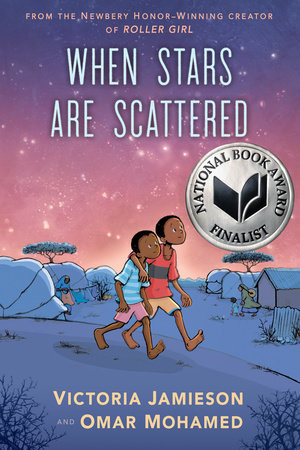
When Stars Are Scattered cover

When Stars Are Scattered — Victoria Jamieson & Omar Mohamed (2020)

Genre: Graphic Memoir
Representation: BIPOC author; refugee experience
YA Source: Penguin Random House Publisher Page

“Hope is the only thing we have.”

Reflection

When Stars Are Scattered is a deeply moving graphic novel memoir that tells the true story of Omar Mohamed and his younger brother, Hassan, growing up in a refugee camp in Kenya after fleeing war-torn Somalia. The narrative combines Omar's personal reflections with the vivid, expressive illustrations of Victoria Jamieson, creating a text that is both emotionally rich and visually compelling. The memoir does more than recount events - it invites the reader into the lived experience of displacement, uncertainty, resilience, and hope. The graphic format humanizes what could be abstract or distant, making it accessible and impactful for young adult readers.

What Stood Out

1. Humanizing a Global Issue - Displacement and refugee life are topics that many students may only encounter through news stories. This memoir brings those realities to a personal level, showing how Omar and Hassan navigate daily life, uncertainty about the future, and the responsibility of caring for family.

2. Graphic Memoir as an Empathy Bridge - The illustrations are integral to meaning, not decorative. Ficial expressions, spatial layouts, and symbolic imagery deepen the emotional resonance. For adolescent readers, the visual narrative creates a bridge into experiences that might otherwise feel distant or overwhelming. 

3. Resilience Without Simplification - The story does not shy away from hardship, but it emphasizes agency, ingenuity, and hope. Omar's determination to seek education, care for his brother, and engage with community resources shows resilience that feels authentic and inspiring. The memoir reminded me that young people are capable of profound insight and agency even in the most difficult circumstances. For the classroom and library, this book serves as a gateway to discussion about global citizenship, equity, and the shared human experience.

Personal Reaction

Reading When Stars Are Scattered was both grounding and enlightening. I was struck by how much weight each small decision carried for Omar and Hassan, whether it was choosing food, navigating bureaucratic challenges, or holding onto hope for resettlement.

Critical Reflection

When Stars Are Scattered extends the possibilities of graphic novel memoir by centering refugee experience through lived testimony. The narrative highlights the ethical complexity of survival, family responsibility, and educational access within displacement contexts. The visual format mediates traumatic content while sustaining narrative integrity and dignity.

Importantly, the memoir positions resilience within structural constraint—offering a counternarrative to simplistic “overcoming” tropes. For adolescent readers, the text supports global literacy and empathy development without romanticizing hardship.

Library & Instructional Application

  • Supports global citizenship education and culturally responsive discussion.
  • Strong anchor for visual literacy and memoir study.
  • Excellent cross-curricular collaboration potential (social studies + ELA).
  • Expanding Cultural Awareness 
    • This graphic novel memoir enhances empathy and global understanding, making it valuable for social studies, world history, and literature units.
  • Encouraging Diverse Voices
    • The inclusion of this book in a YA collection signals a commitment to narratives that reflect a wide range of lived experiences beyond the context of the United States.
  • Programming & Dialogue
    • This book could anchor library-led discussions or collaborations with social studies teachers on topics such as refugee experiences, cultural adaptation, or global justice
  • Discussion Questions
    • 1. How do Omar's responsibilities toward his brother shape his choices and growth?
    • 2. In what ways does the graphic format help you connect emotionally with the characters?
    • 3. What does When Stars Are Scattered teach us about community, survival, and hope?

Final Thoughts

When Stars Are Scattered is essential YA literature because it invites adolescent readers to step into the world of another person with empathy and curiosity. It challenges assumptions about what it means to belong and highlights the strength and resilience that can emerge even in uncertain circumstances. This graphic novel memoir belongs on classroom shelves and in library collections as a text that teaches both history and humanity.

YA Book Reviews - They Called Us Enemy - George Takei


They Called Us Enemy — George Takei (2019)

Genre: Graphic Memoir; Historical Nonfiction
Representation: BIPOC author; LGBTQ+ author/voice
YA Source: Top Shelf Publisher Page


“They called us enemy. But we were American.”

Reflection

They Called Us Enemy is a searing, illuminating graphic novel memoir that chronicles George Takei's childhood experience in the Japanese American internment camps during World War II. Told in rich, accessible comic narrative, the book pulls the reader into the emotional reality of being uprooted, dehumanized, and confined simply because of one's heritage. What makes this work especially compelling as adolescent literature is its combination of visual storytelling with historical gravitas. The graphic novel format bridges the intense emotionality of a memoir with the accessibility many YA readers crave. It doesn't sanitize history, but instead invites readers to feel, not just learn, from the past.

What Stood Out

1. Universal Themes Through a Personal Lens - Takei's personal narrative, interwoven with the larger historical context of Executive Order 9066, places human faces and feelings onto abstract history. This helps readers grasp how political actions affect real families and real children.

2. Graphic Novel as a Powerful Vehicle for Memory - The artwork is intentional and evocative. Panel designs, pacing, and visual metaphors deepen the emotional impact beyond what text alone might convey. For adolescent readers who be more visual learners, this format becomes a gateway to empathy and critical historical awareness. 

3. Relevance to Contemporary Issues - While grounded in mid-20th century history, the memoir resonates today with ongoing discussions about civil liberties, xenophobia, and belonging. It prompts readers to question narratives of nationalism, identity, and justice - making it relevant to teen readers navigating their ideas about self and society.

Personal Reaction

As I read They Called Us Enemy, I was deeply moved by how Takei reclaimed and shared a chapter of his life that many historical curricula marginalize or gloss over. What stayed with me most was how the memoir illustrates that injustice is not just a historical footnote; it affects children, families, and communities in ways that ripple across generations. This book reminded me of the power of firsthand memory. For adolescent readers, particularly those encountering stories that reflect trauma or marginalization, They Called Us Enemy doesn't just educate, it validates. It shows that individual narratives matter.

Critical Reflection

They Called Us Enemy situates personal narrative within collective historical trauma. Through the graphic memoir format, Takei explains the Japanese American incarceration experience through accessible means without diminishing its gravity. The visual narrative demands attention to expression, panel pacing, and spatial composition—reinforcing that memory is both textual and visual.

For adolescents, the memoir functions as a civic literacy text: it illustrates how fear and prejudice can erode civil liberties and invites readers to examine national narratives that are often simplified in traditional curricula.

The multimodal structure democratizes access to complex historical content, supporting comprehension for visual learners and offering an entry point to rigorous discussion for a wide range of readers.

Library & Instructional Application

  • Strong pairing with WWII and constitutional rights units (social studies/ELA collaboration).
  • Ideal for book clubs centered on civic responsibility and historical empathy.
  • Supports visual literacy instruction and analysis of how images shape meaning.
  • Supports Historical Literacy 
    • This graphic novel memoir is an excellent resource for U.S. History units on World War II, civil rights, and constitutional issues. It helps students engage with history on a human level.
  • Expands Definitions of Literature
    • Including They Called Us Enemy in YA collections signals that memoir and graphic novels are valued literary forms, not secondary to prose narratives.
  • Programming Potential
    • This book could anchor discussions, library displays, and cross-curricular integration (English/History). Activities such as graphic novel memoir circles, historical writing projects, and empathy-based discussions about "what would you do?" can deepen student engagement.
  • Discussion Questions
  • 1. How does the graphic novel format influence your understanding of the events described?
  • 2. What similarities or differences do you notice between Takei's childhood experience and other histories of forced displacement?
  • 3. In what ways does They Called Us Enemy help you think about fairness, rights, and civic responsibility?